
AI for Customer Feedback Analysis: Turning Customer Voices into Actionable Business Intelligence
In the digital-first world, customer feedback is one of the most valuable assets a business can possess. Every review, survey response, chat message, or social media comment represents a direct line to customer expectations, satisfaction levels, and pain points. However, as businesses grow, the volume of feedback increases rapidly, making it difficult to analyze manually and consistently.
Artificial Intelligence (AI) has emerged as a powerful solution to this challenge. AI for customer feedback analysis allows businesses to process large volumes of unstructured data, identify patterns, understand sentiment, and extract actionable insights in real time. Instead of reacting late to customer dissatisfaction, companies can proactively improve experiences, products, and services.
This blog explores how AI transforms customer feedback analysis, the technologies behind it, its benefits, real-world applications, and how businesses can adopt it effectively.
Why Customer Feedback Analysis Is Critical for Modern Businesses
Customer expectations are evolving faster than ever. With multiple touchpoints such as websites, apps, customer support channels, and social platforms, feedback is generated continuously. Ignoring or misinterpreting this feedback can lead to customer churn, reputational damage, and missed growth opportunities.
Traditional feedback analysis methods rely heavily on manual review, spreadsheets, or limited survey summaries. These approaches are time-consuming and often fail to capture the full picture. Important insights get buried in large datasets, and decisions are made based on partial or outdated information.
AI enables businesses to move beyond surface-level feedback analysis. By continuously monitoring and analyzing customer input, organizations gain real-time visibility into customer sentiment and expectations, allowing them to act faster and more confidently.
What Is AI-Powered Customer Feedback Analysis
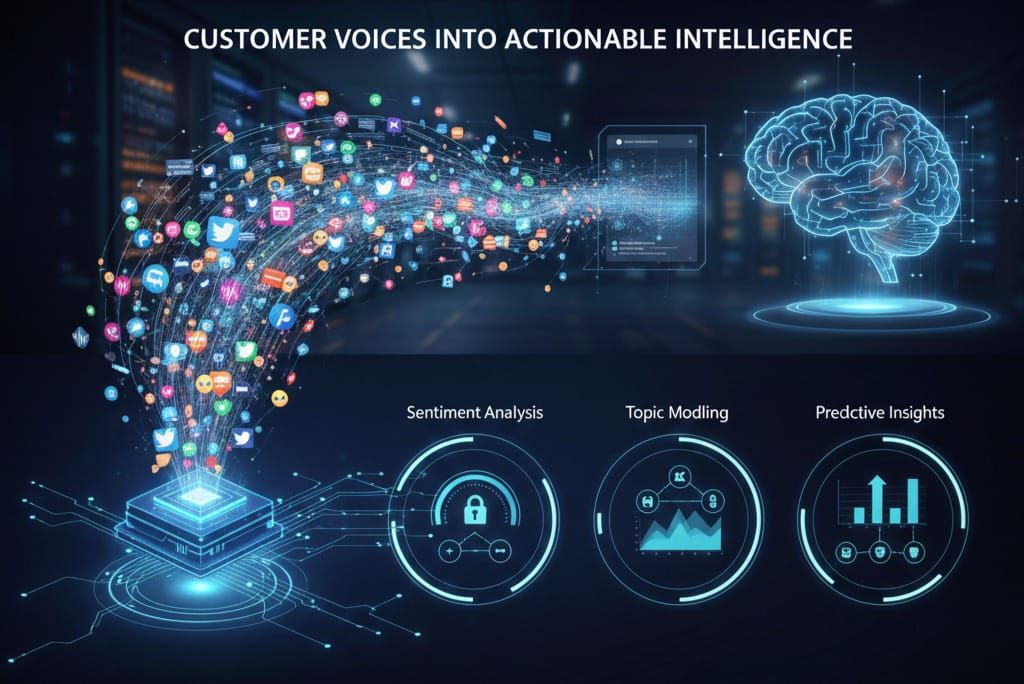
AI-powered customer feedback analysis uses machine learning and natural language processing to automatically interpret customer input across different formats and platforms. It can analyze text, voice transcripts, and even emojis to understand what customers are saying and how they feel.
Unlike traditional keyword-based systems, AI understands context, intent, and emotional tone. This allows businesses to detect not only whether feedback is positive or negative but also why customers feel that way. Over time, AI models improve their accuracy as they learn from new data.
The result is a scalable, intelligent system that transforms raw customer feedback into structured, meaningful insights.
Core Technologies Behind AI Feedback Analysis
Natural Language Processing (NLP) plays a foundational role in AI feedback analysis. It enables machines to understand and interpret human language, including variations in grammar, tone, and phrasing. NLP allows AI systems to process reviews, chat messages, and survey responses as humans would—only much faster.
Sentiment analysis is another critical component. It determines whether customer feedback expresses positive, negative, or neutral sentiment. Advanced sentiment models go further by detecting mixed emotions and intensity, offering a more nuanced understanding of customer opinions.
Topic modeling and theme detection help identify recurring issues and trends. AI groups feedback into categories such as product quality, pricing, customer support, or delivery experience. This enables teams to prioritize improvements based on what customers mention most frequently.
Emotion detection adds an additional layer of insight. By identifying emotions like frustration, excitement, or disappointment, businesses can tailor responses and interventions more empathetically.
Predictive analytics uses historical feedback data to forecast future outcomes, such as customer churn or declining satisfaction, enabling proactive decision-making.
Sources of Customer Feedback AI Can Analyze
AI systems are capable of analyzing feedback from a wide range of sources. These include customer surveys such as CSAT, NPS, and CES, online reviews on marketplaces and app stores, social media comments and brand mentions, live chat and chatbot conversations, support tickets and emails, and call transcripts from voice support systems.
By consolidating feedback from multiple channels, AI provides a unified view of customer sentiment. This holistic perspective ensures that no critical insight is missed and that decisions are based on comprehensive data rather than isolated feedback points.

Benefits of Using AI for Customer Feedback Analysis
One of the most significant advantages of AI is speed. AI analyzes feedback in real time, allowing businesses to respond immediately to emerging issues. This real-time capability prevents small problems from escalating into major customer experience failures.
AI also offers unmatched scalability. Whether a company receives hundreds or millions of feedback entries, AI processes them with consistent accuracy and efficiency, without increasing operational costs.
Improved customer experience is another key benefit. By identifying pain points early, businesses can refine their offerings, improve support processes, and enhance overall satisfaction.
AI reduces human bias by applying consistent evaluation standards across all feedback. This leads to more objective insights and better-informed decisions.
Ultimately, AI-driven feedback analysis helps businesses retain customers, increase loyalty, and drive long-term growth by aligning operations with real customer needs.
Real-World Applications of AI Feedback Analysis
In e-commerce, AI helps identify recurring complaints related to product quality, shipping delays, or unclear descriptions. These insights allow businesses to optimize listings, logistics, and supplier performance.
For SaaS companies, AI analyzes in-app feedback, onboarding surveys, and support tickets to uncover usability issues and feature requests. This data directly informs product roadmaps and development priorities.
Customer support teams use AI to classify tickets based on urgency and sentiment. High-risk or frustrated customers can be prioritized, leading to faster resolution times and improved satisfaction.
Marketing teams leverage AI to monitor brand sentiment across social media and reviews. This helps them measure campaign effectiveness and respond quickly to public perception shifts.
Product teams rely on AI insights to validate ideas and ensure that new features address real customer problems rather than assumptions.
Integrating AI Feedback Analysis into Automation Workflows
The true power of AI feedback analysis emerges when it is integrated into automation workflows. AI insights can trigger automated actions such as creating support tickets, sending alerts to internal teams, or updating analytics dashboards.
For example, negative sentiment detected in reviews can automatically notify customer success teams. Feature requests can be logged into product management tools. Satisfaction trends can update business intelligence dashboards in real time.
This closed-loop system ensures that feedback does not remain static data but becomes a driver of continuous improvement.
Challenges and Limitations of AI Feedback Analysis
Despite its advantages, AI feedback analysis has limitations. Poor data quality can affect accuracy, especially when feedback is vague or incomplete. AI may also struggle with sarcasm, cultural nuances, or ambiguous language.
Over-reliance on automation can be risky. Human oversight is essential for interpreting sensitive feedback and making final decisions.
Privacy and data security are also critical considerations. Businesses must ensure compliance with data protection regulations when processing customer information.
Understanding these challenges allows organizations to implement AI responsibly and maximize its effectiveness.
Best Practices for Successful Implementation
To implement AI feedback analysis effectively, businesses should start with clear objectives. Knowing what insights are most valuable helps guide system design and data collection.
Centralizing feedback from all channels ensures comprehensive analysis. Combining AI insights with human review enhances accuracy and empathy.
Continuous model training and improvement are essential for long-term success. Most importantly, businesses must act on insights promptly to deliver real value.
The Future of AI in Customer Feedback Analysis
The future of AI feedback analysis lies in predictive and autonomous systems. AI will not only analyze feedback but also recommend actions and resolve issues automatically. Voice emotion analysis, real-time personalization, and proactive customer experience optimization will become standard.
As AI evolves, customer feedback analysis will shift from reactive reporting to proactive experience design, enabling businesses to stay ahead of customer expectations.